
 A conversation with Ioannis Orfanos, Partner & Head of Capital Markets, Colliers Greece & Cyprus
In our latest interview, Mr. Ioannis Orfanos – Partner & Head of Capital Markets at Colliers Greece & Cyprus – explains how high-profile mixed-use developments and hotel-branded residences are elevating Greece into a premier Mediterranean living destination, attracting foreign high-net-worth buyers and redefining urban and coastal living. Yet amid this luxury boom, Mr. Orfanos emphasizes the importance of balanced development: sustainable growth must also address mid-market housing and local affordability to avoid long-term imbalances. Read the full interview to discover how Greece is reinventing its real estate market and what this means for investors, developers, and the future of the hospitality sector.
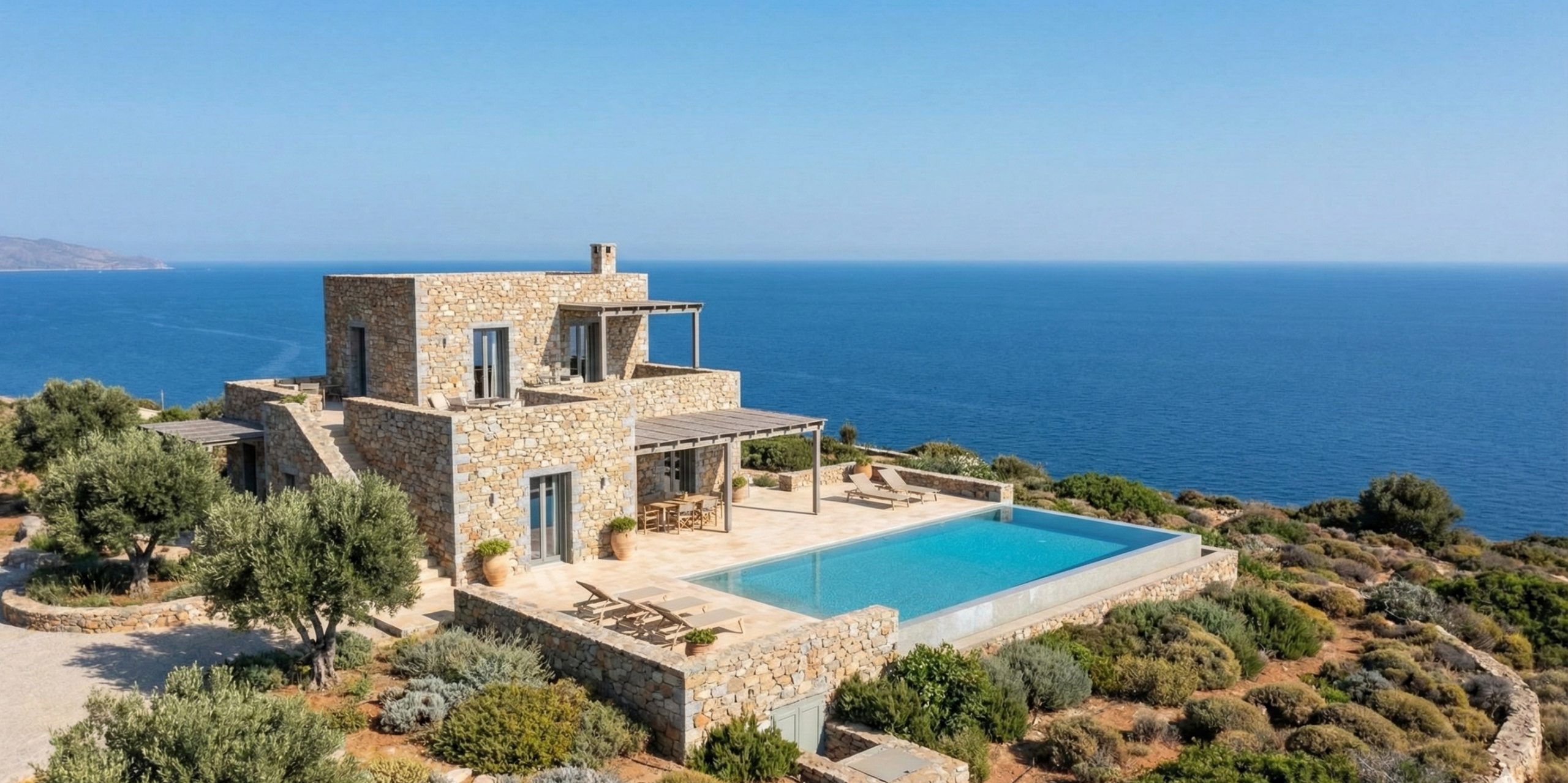
The boom in luxury residential projects and branded resort residences
1. Greece’s residential boom has centered on high-end projects aimed at international buyers. What is driving this transformation?
The shift in Greece’s residential market, particularly in Greater Athens, has been both profound and deliberate. What we are witnessing is not a short-lived post-pandemic surge, but “a structural repositioning of the country as a premier Mediterranean living destination”. New major mixed-use developments with luxury hotel-branded residences have fundamentally raised expectations of what urban and coastal living in Greece can be.
Iconic projects such as The Ilisian (formerly Hilton) in Athens, Costa Navarino and Navarino Bay in South West Peloponnese, Amanzoe in Porto Heli, One&Only resorts in Kea and in Glyfada, Athens, as well as some new branded concepts emerging in Crete and other popular islands, are redefining the blend of lifestyle, hospitality and residential living. These developments have set a new benchmark, elevating Athens and core resort destinations into global luxury markets. Foreign high-net-worth buyers, along with internationally active Greek expats, are driving much of the demand and increasingly view Greece as either a primary base or an attractive second residence. Domestic buyers, too, are gravitating towards upscale luxury, amenity-rich offerings, accelerating the market’s maturation.
2. How significant are branded resort residences in attracting investment to Greece?
Branded resort residences have become a powerful catalyst for new hospitality investment in the Greek market. For capital markets, they bring credibility, operational clarity and a differentiated product, qualities that institutional investors value highly.
The investment narrative today revolves around integrated residential concepts within a hospitality resort or as part of a major city hotel that deliver both lifestyle and financial resilience. Brands bring not only global standards and marketing power, but also a built-in audience of loyal guests who understand and trust the product. This enhances absorption rates, pricing strength and long-term liquidity.
3. Is there still room for price growth in Greece’s luxury residential segment?
Greece’s long-held “value-for-money” advantage has narrowed as prices converge with those in Spain, Portugal and parts of the French Riviera. Even so, Greece’s appeal rests on a mix that remains difficult to match: stability, climate, natural beauty, and an increasingly sophisticated real estate offering.
If the luxury segment continues to prioritise sustainability, service excellence and mixed-use experiential concepts rather than excess for its own sake Greece will remain highly competitive. Today’s luxury buyers are more analytical and well-informed than ever. They benchmark Greece directly against top Mediterranean markets. Nevertheless, resort-integrated and branded residential offerings continue to command premiums, justified by their service levels, design quality and operational consistency.
Balancing Luxury Growth and Housing Affordability
4. With luxury prices rising, should locals worry about affordability?
There is no denying that the rapid growth of luxury developments has constrained the supply of mid-market housing. The misconception that every project must target international buyers has created a mismatch between local needs and new supply.
This is neither socially responsible nor economically sustainable. Greece needs balance. Without a pipeline of quality, attainable housing for young households, professionals, and retirees, the market risks developing structural weaknesses.
5. How can Greece ensuring accessible housing for locals while continuing to attract luxury investments?
Greece must pursue a dual-track strategy. Premium investment is vital, it drives tourism, creates jobs and elevates the national brand. However, it must be complemented by purpose-built mid-market housing.
The challenge lies in rising construction costs, limited land availability, and outdated regulatory frameworks, which make mid-market development unprofitable. Consequently, most new residential projects are targeting high-end buyers, often incorporating additional services and amenities that push prices further upward.
6. Are investors showing interest in mid-market or affordable housing? What would unlock this segment?
Yes, interest is emerging, especially from developers who deeply understand residential fundamentals and see the latent demand. However, the business case remains difficult without policy support.
To unlock this sector, Greece will need aligned incentives: tax benefits for affordable housing, planning flexibility, improved permitting timelines and financing schemes supported by EU structural funds and local banks. Without such measures, Greece risks missing not only a social imperative but also a significant investment opportunity.
7. In fact, the Greek government recently doubled the Golden Visa investment threshold in key areas partly to address housing cost concerns. How else might policymakers and the industry help affordability? What else must be done?
Raising Golden Visa thresholds is a step in the right direction, just as limiting short-term rentals in saturated zones has been. “But the underlying issues are far deeper. Two structural challenges must be addressed.
First, Greece has tens of thousands of vacant and underutilised residential units, particularly in Athens. These are often locked in inheritance disputes, fragmented ownership, NPL structures or REOCo portfolios. They must be activated through targeted taxation on long-term vacancy, incentives for renovation and streamlined pathways for consolidation.
Second, Greece needs a modern planning framework that allows rational density where urban infrastructure can support it. This does not mean skyscrapers; it means permitting 8 10 storey developments in areas currently restricted to 2 3 floors, paired with green spaces, mobility upgrades and infrastructure investment. Similarly, expanding out of plan areas into urban zoning, against fair compensation, would unlock substantial new supply.
A third axis is regional economic development. Greece must reduce its dependence on Athens by boosting employment in other cities through investment in manufacturing, production, agriculture, education, technology, and infrastructure. Decentralisation would naturally ease housing pressures in the capital.
8. What trends are shaping institutional and cross-border investment demand?
In recent years, we have seen major hotel transactions and large upgrade CapEx commitments across the country, supported by both international and domestic platforms, especially in major touristic hotspots such as Crete, Rhodes, Mykonos, Santorini and Corfu. Upscaling, expanding and rebranding existing resorts together with city hotel repositionings continue to lead the investment wave, signaling strong investor conviction. We also see growing interest from international hospitality groups, operators and funds to expand beyond traditional destinations and enter markets such as Thessaloniki, Kos, Paros, Porto Heli, Zante and Milos. Greece’s hospitality pipeline is well above €3 billion in planned investment, one of the most active in the Mediterranean.
The lack of modern mid-market hotels, serviced rental and co living accommodation, such as for young professionals and students as well as for senior living, is becoming increasingly visible. As the market matures, institutional investors will eventually look toward these sectors as the next frontier of opportunity.
9. What is your outlook for 2026? Are investors still bullish despite global uncertainty?
Investor appetite remains robust. Greek tourism has shown extraordinary resilience, posting multiple record years and extending the season well into spring and autumn. Investors and experienced hoteliers recognise the structural depth of demand and the increasing shift toward year-round experiences across Athens, the islands and the mainland.
Both domestic and international capital continue to target 4 and 5 star assets, whether through repositioning or greenfield development. Sustainability-driven investments are expanding rapidly, supported by EU RRF financing through the local banking system. Meanwhile, wellness, adventure, gastronomy, culture and paired business-leisure propositions are shaping the next generation of Greek hospitality.
10. What advice would you give international investors entering Greece today?
Invest in quality and scale. The most successful deals in Greece have been those grounded in authenticity, operational excellence and long-term resilience. Investors should be prepared for planning complexity and lean heavily on strong local partners, who understand permitting, market dynamics and regional nuances.
ESG compliance, wellness integration and experiential design are now central to value creation.
With many thanks to Mr Orfanos for sharing his insights with us!
For more information, please contact us at k.logaras@logaraslaw.com.